Platforms
AIKON Platform
Main platform for computer vision analysis of historical documents
AIKON Demo
Demo version showcasing platform capabilities
 AIKON: A Modular Computer Vision Platform for Historical Corpora
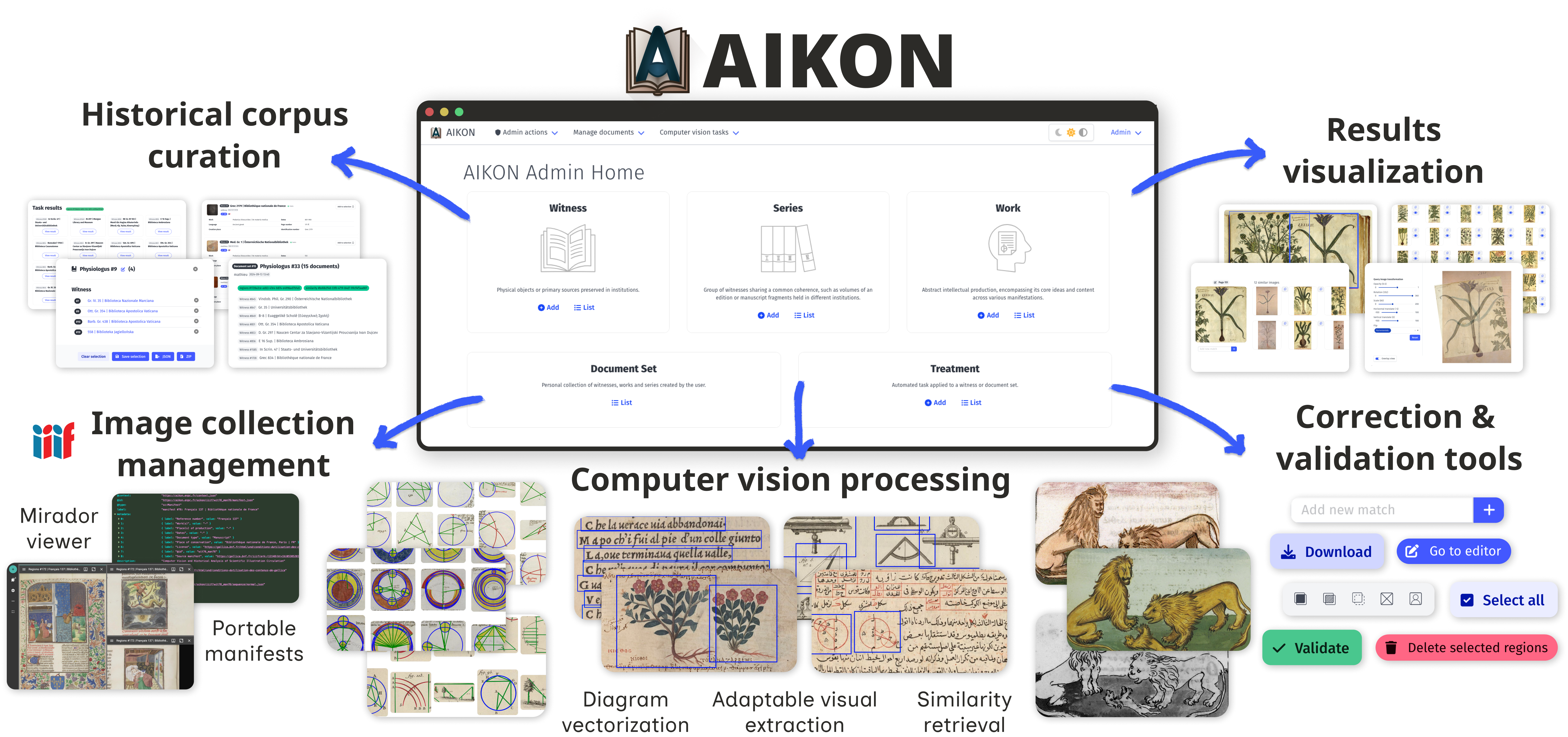
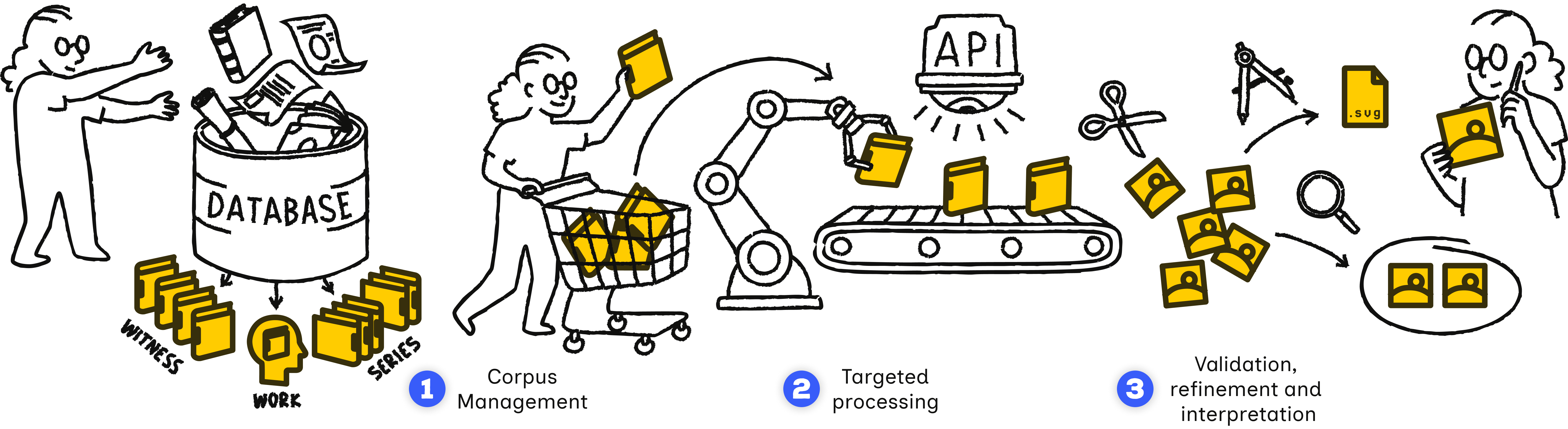
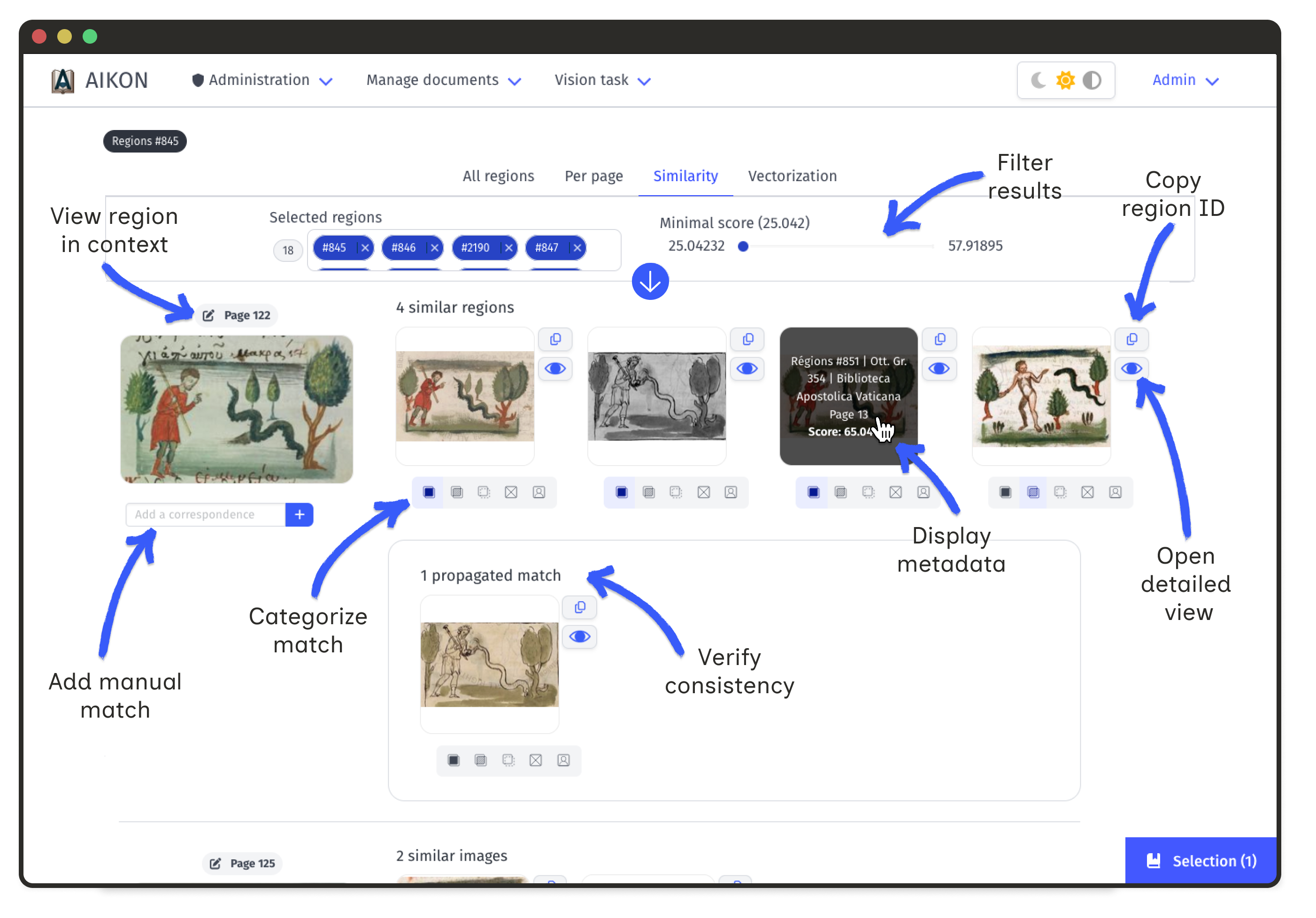
Historical document analysis has progressed to a point where the main bottleneck for many historical applications is not algorithms, but relevant interfaces, that can support historians’ workflow. While specialized tools exist for text processing and image search, we argue the community lacks a versatile collaborative platform enabling historians to analyze their own corpora from a particular perspective. As a step in this direction, we present AIKON, a modular web-platform designed to empower historians with computer vision tools. AIKON implements a complete workflow for historical document analysis, from corpus constitution to ai outputs validation and interpretation. It provides a comprehensive research environment combining source management tools with automated processing capabilities as well as multi-user validation and visualization interfaces. We showcase the potential of AIKON by presenting modules enabling the investigation of graphical content transmission across large and diverse corpora, a problem for which few modern tools exist, and which is of key interest, for example in History of Science.
Main platform for computer vision analysis of historical documents
Demo version showcasing platform capabilities
At its core, Aikon allows researchers to describe their sources, import scans, request automatic processing, and manually refine results. Built on proven technologies and interoperable formats, including established standards such as IIIF, the platform's architecture supports a wide range of visual materials. Aikon's data model, centered around the concepts of Series, Witness, and Content, provides a flexible framework capable of describing diverse source materials while facilitating alignment across varied corpora.
The platform's modular structure enables easy integration of additional functionalities, with current applications including illustration extraction, similarity search, and vectorization. Aikon is not tied to any predetermined analysis methods; all stages can be performed manually or automated, with specialized models customizable to specific datasets. This approach ensures adaptability to various research needs while maintaining reproducibility. By fostering interdisciplinary collaboration and sustainability across digital humanities projects, Aikon aims to assist researchers to explore corpora at an unprecedented scale, helping to bridge the gap between advanced computational methods and the nuanced requirements of humanities research.
EdIter et analyser les Diagrammes astronomiques historiques avec l'intelligence Artificielle
ANR-22-CE38-0014To get an account on aikon.enpc.fr to try all platform features, don't hesitate to contact us.
Explore the Aikon project and contribute to its development on GitHub .
@article{albouy2026aikon,
    title={{AIKON : A Modular Computer Vision Platform for Historical Corpora}},
    author={
        Albouy, Ségolène and
        Norindr, Somkeo and
        Kervegan, Paul and
        Aouinti, Fouad and
        Delanaux, Rémy and
        Champenois, Robin and
        Grometto, Clara and
        Lazaris, Stavros and
        Guilbaud, Alexandre and
        Husson, Matthieu and
        Aubry, Mathieu
    },
    url={https://doi.org/10.1007/s10032-026-00581-x},
    year={2026},
    month={June},
    journal={International Journal on Document Analysis and Recognition (IJDAR)},
    keyword={Digital Humanities, Computer Vision, Historical Documents, Visual Analysis},
}